
What environmental indicators of concrete and prefabricated elements are worth analyzing before evaluating the product?

Environmental declarations for concrete and precast elements provide manufacturers and contractors with verifiable data on the product’s environmental impact. Investors can precisely assess a material’s carbon footprint before selecting a supplier, initiating public tenders, or certifying buildings in green building systems.

What business questions does an environmental assessment solve?

This document defines the actual environmental impact of a material within the framework of sustainable construction . As a certification body, we observe that analyzing concrete EPDs facilitates the comparison of different formulations in terms of final greenhouse gas emissions. This provides producers with hard data for non-financial ESG reporting. Such analyses allow them to efficiently meet the stringent requirements of the European standard EN 15804, set by general contractors.

How to read the GWP indicator and what influences its value?

The GWP (global warming potential) measures the global warming potential (GWP) in kilograms of CO2 equivalent per specific unit of product . In the case of commodity mixtures, the final result depends directly on the selected quantity and fraction of cement. The clinker production process itself generates the greatest environmental impact during the initial extraction of raw materials and firing in industrial kilns. Reducing this factor in modern plants is achieved through careful dosing of additives such as blast furnace slag or fly ash.

How to check process performance based on data?

The level of primary energy and natural resource consumption indicates the degree of technological optimization of the entire production facility . Low material requirements demonstrate the high energy efficiency of the implemented recipe.

Analysis of these parameters directs companies to specific areas requiring improvement:

  • use of aggregates from local construction recycling,
  • powering concrete batching plants from renewable energy sources,
  • implementation of cements with a significantly reduced carbon footprint.

Which life cycle phases dominate the concrete balance sheet?

Emission reports for binders are always dominated by the initial production stages, described as modules A1–A3 . This breakdown includes the physical extraction of raw materials from the mine, internal transport to the plant, and the production of the finished mix itself. Combining these results with the delivery phases to the construction site (A4) distorts the conclusions of the analysis. The environmental costs of transport depend on the location of a specific investment, and therefore are not a fixed characteristic of the product itself.

How do we supplement EPD indicators with research?

In our certification body’s practice, we compare strength test results with the environmental parameters of a given formulation . Our in-house laboratory facilities allow us to verify how changing the composition to reduce emissions affects the physical properties of the material. Manufacturers receive a comprehensive picture, with mechanical and fire certifications providing a secure basis for carbon footprint calculations.

Preparation of documentation for tender requirements

The process of verifying performance characteristics involves developing a complete technical specification for a given material . Collected test reports, along with emission indicators, are transferred directly to product data sheets. This structured offer makes it easier for suppliers to quickly attach the correct attachments to tender documentation and prevents the material from being rejected by the supervisory inspector.

The importance of additional strength tests

Environmental analysis alone does not replace a national technical assessment in areas requiring absolute confirmation of fire or load resistance. Laboratory testing demonstrates the ultimate suitability of concrete for targeted emergency situations . Verification of compliance with building standards protects the investor against construction errors at an early stage of design.

If you are planning to introduce new types of prefabricated products into regular sales, it is a good idea to verify their physical parameters in an accredited laboratory before formally entering the market.

The EPD for concrete and precast elements enables a precise assessment of a material’s environmental impact, focusing on GWP and stages A1–A3. Combining emission data with strength testing is crucial, ensuring compliance with standards and tender requirements. Optimizing formulations through the selection of appropriate cement additives translates into a reduced carbon footprint while maintaining full technical parameters.

FAQ

Why are the life cycle stages A1 to A3 most often analyzed for concrete?

These phases include raw material procurement, transportation to the plant, and the production process itself, which generate the greatest environmental impact for bonding products. Focusing on these modules allows for an objective comparison of material properties across suppliers, regardless of the specific construction site location.

How do cement additives, such as fly ash, affect the EPD parameters of concrete?

Using additives with a lower carbon footprint instead of clinker allows for a significant reduction in the global warming potential (GWP). However, composition optimization must be confirmed by laboratory testing to ensure the required structural strength while reducing greenhouse gas emissions.

What is the significance of the primary energy consumption indicators included in the declaration for tendering processes?

These indicators demonstrate the plant’s technological efficiency and allow investors to assess the material’s compliance with sustainable building regulations. Complete documentation, combining energy consumption data with technical certificates, facilitates bid verification by supervisory inspectors and designers.


Posted in EPD

Benefits of Certification Training for Construction Manufacturers

In an era of dynamic legislative changes and growing pressure on sustainable construction, participating in courses and training on construction product certification offers significant benefits for manufacturers. Primarily, they provide information on the norms and standards their products must meet. This allows them to better prepare for the actual certification process. Instead of viewing certification courses as just another “paper for collection,” it’s worth viewing them as an investment in credibility and cost optimization. In this article, we’ll examine how participating in such events impacts a company’s market position, production safety, and the trust of the most demanding contractors. 

Who should benefit from certification training?

Certification training should be considered by construction manufacturers seeking to gain the necessary knowledge about changing regulations and market practices. Participating in such events is crucial to understanding the requirements they must meet, particularly for new market players and companies planning to introduce innovative products. These training courses are also important for companies seeking to improve their production processes and adapt to environmental standards. 

It’s worth noting that participation in training programs also supports building environmental awareness among employees . This allows teams to become better prepared to implement sustainable development principles and make informed decisions regarding strategic plans that will enhance their brand development. Ultimately, investing in training translates into benefits for both the company itself and the entire construction sector. Therefore, it’s worth considering participation in such initiatives as part of a company’s development strategy and the pursuit of high standards of quality and environmental responsibility. In particular, certification training supports increased market competitiveness, which is crucial given the dynamic changes taking place in the construction industry. 

Implementation of knowledge acquired during training

To effectively implement the knowledge gained during training, for example, on environmental performance declarations (EPDs), it’s worth focusing on several key aspects. First and foremost, develop an action plan that addresses all stages of the certification process and appropriate deadlines for individual tasks. It’s also crucial to engage employees in the certification preparation process, allowing them to better understand the requirements and expectations associated with specific standards. It’s also worthwhile to utilize available resources and tools, such as reports, statistical summaries, and e-learning platforms, which can facilitate knowledge acquisition and practical application. This will streamline the certification process and allow the company to maximize the benefits of possessing appropriate qualifications in various areas. 

Benefits of Certification Training for Construction Manufacturers

Training related to EPD certification and the changes included in the new CPR regulation supports construction product manufacturers in understanding the requirements for environmental declarations and the new System 3+ conformity assessment system. Knowledge gained during training allows them to identify areas for improvement in production processes, which allows for cost and resource optimization. Training also helps build environmental awareness among employees, which is crucial for the sustainable development of the construction industry. 

We cordially invite you to participate in our training courses and conferences, which will help you improve the quality of your products and enhance your market competitiveness. Leverage the knowledge of industry experts to better understand certification requirements and drive innovation within your company.   

FAQ

Why is it worth investing in certification training?

Investing in such training brings tangible benefits to both employees and employers. It translates into increased work efficiency, enabling faster implementation of new technologies and best practices. Companies achieve better financial results and gain a competitive advantage thanks to employee innovation and lower employee turnover.  

What are the benefits of certification training for construction manufacturers?

Certification training for construction manufacturers is not just a formality, but above all a strategic tool for building a competitive market advantage. It provides a solid understanding of standards and regulations, such as changes to the Construction Products Regulation (CPR), which facilitates certification processes and raises standards for product quality and performance.  

What should be considered when implementing the knowledge gained from certification training?

Implementing knowledge from certification training requires a systematic approach to avoid omitting important issues and ensure real future benefits. Planning activities, implementing them effectively, and monitoring the results are crucial.

Posted in EPD

EPD certificate in construction – the key to sustainable development

The EPD plays a key role in the construction industry, especially in the context of long-term strategic planning. Faced with the growing need for sustainable development, possessing this document underscores its importance for competitiveness and customer trust. EPDs allow companies to differentiate themselves in the market, increasing their chances of winning public tenders. Collaboration with clients from Poland and Europe and support in the process of creating and obtaining EPDs are compelling advantages. We encourage you to read the rest of this article to discover the full potential of this certificate.

What are the benefits of the EPD certificate?

An EPD certificate brings numerous benefits to companies, including increased market competitiveness and customer confidence. Possessing this document influences the perception of the company by consumers, who value transparency and environmental responsibility. As a result, there is a greater chance of winning public tenders, as Environmental Product Declarations are often required. The process of obtaining an EPD certificate involves several stages, including data collection and verification, as well as a life-cycle analysis. Collaboration with experts in this field allows for a smooth and effective procedure .

It’s also worth noting that EPD certification is crucial for environmental protection and the sustainable development of the construction industry. Companies operating in accordance with ecological principles have the potential for long-term development and a positive impact on the environment. Collaboration with clients indicates a growing interest in this topic and the need for assistance in developing and obtaining EPD certifications.

The process of obtaining an EPD certificate

Obtaining an EPD certificate requires completing several key stages that are crucial for long-term company planning. The first step is defining the scope of products covered by the declaration . Information regarding their environmental impact throughout their entire life cycle is then collected. The next step is verification and conducting a life-cycle analysis, enabling a precise determination of the impact of construction products on the environment. Ultimately, a final draft declaration is created, containing all the necessary information. Collaboration with clients from Poland and other European countries, as well as assistance in developing and obtaining EPDs, are crucial aspects shaping company strategies. This allows them to better adapt their operations to market requirements and customer expectations. The EPD certificate thus becomes a tool supporting the sustainable development and competitiveness of companies in the construction industry, positively impacting their long-term planning and market success.

The impact of EPD on the future of the construction industry

EPDs play a key role in the future of the construction sector, particularly in relation to sustainability. These declarations can shape companies’ long-term strategies, allowing for better adaptation to market demands and customer expectations. As society’s environmental awareness grows, companies will invest in EPD-based solutions to remain competitive. As a result, we can expect changes in the construction industry, such as a greater emphasis on environmentally friendly materials and technologies and the development of innovative construction methods . Collaborating with clients in Poland and other European countries, as well as assisting in the development and acquisition of EPDs, are essential aspects of the strategy of companies seeking to succeed in the market.

The importance of the EPD certificate in the long-term planning of construction companies

The EPD certification is a key element in the long-term strategic planning of construction companies, increasing their competitiveness and customer trust. Having an EPD allows companies to differentiate themselves in the market , which translates into a greater chance of winning public tenders. The certification process involves defining the product scope, collecting and verifying data, and conducting a life-cycle analysis, which supports sustainable development and positively impacts company strategies. As environmental awareness grows, the EPD is shaping the future of the construction industry by promoting innovative and eco-friendly solutions.

Invest in the future of your construction company by obtaining EPD certification, which will increase your competitiveness and customer trust. Contact our experts to learn how to effectively complete the certification process and stand out in the market.

FAQ

Why is the EPD certificate important for construction companies?

The EPD certificate increases companies’ competitiveness in the market and builds customer trust, which can help them win public tenders.

What steps are needed to obtain an EPD certificate?

The process includes defining the product scope, collecting and verifying data, and analyzing the product life cycle.

What do companies gain from having an EPD certificate?

Companies with EPD certification can better adapt to market requirements, promoting sustainable development and innovative solutions.

Posted in EPD

Verification tests in EPD certification

Verification tests in EPD certification

A Type III Environmental Product Declaration (EPD) is a document that transparently and standardizes the environmental impact of a product throughout its life cycle. It is increasingly becoming a market requirement, especially in sectors such as construction, industry, and materials production. To be credible and commercially viable, the declaration must be prepared in accordance with appropriate standards and independently verified. Below, we explain how this process works in practice.

Standards and legal basis for the environmental product declaration

The basis for preparing an environmental product declaration are international standards, primarily

ISO 14025 , which defines the principles for developing Type III declarations, is complemented by ISO 14040 and ISO 14044 , which regulate the conduct of product life cycle analysis (LCA). At this stage, it is also crucial to define the system boundaries, i.e., determine which stages of the product’s life are being analyzed – from raw material acquisition, through transport and production, to use and disposal. Equally important is compliance with the relevant Product Category Rules ( PCR ), which specify requirements for a given industry and ensure the comparability of declarations.

Data collection and product life cycle analysis (LCA)

The next step is to collect detailed environmental data, which includes the quantity and transport of raw materials used, energy and water consumption, air and water emissions, and the amount of waste generated . This data should be current (no older than two years), complete (covering the entire production process), and verifiable (supported by appropriate documents, such as quality cards or invoices), as it directly impacts the analysis results, particularly those related to the production phase. In practice, this process requires collaboration across various departments within the company and often suppliers. The data is then processed as part of an LCA analysis using specialized software that allows for the calculation of indicators such as global warming potential (GWP), primary energy consumption, and acidification potential. This is one of the more demanding steps in preparing an environmental product declaration , but with proper collaboration, the process can be carried out effectively, ensuring compliance with standards.

Development of the content of the product’s environmental declaration

Based on the results of the LCA analysis, an environmental product declaration ( EPD) is prepared . This document should include a clear description of the product and its basic properties and functions, information on the methodology used, the assumptions made, and a clear summary of environmental performance. It is important that the content of the declaration is understandable, objective, and compliant with the requirements of the ISO 14025 standard , while avoiding marketing content. The declaration must enable comparisons between products within the same category, so particular attention is paid to data consistency and presentation . It is worth remembering that the document itself is valid for five years from its official date of issue. If significant changes occur during this time regarding the product or its production, an EPD update would likely be necessary. 

Verification and publication of the declaration of compliance with standards

The final stage is the verification of the environmental product declaration by an independent certification body. Its purpose is to confirm the document’s compliance with applicable standards and EPD program rules. Only after a positive assessment can the declaration be published and officially used in business relations, tenders, and technical documentation. For many companies, this is also a crucial element of their ESG strategy and building credibility in the field of environmental responsibility. A properly prepared and verified environmental product declaration not only meets formal requirements but also provides real support in communicating with the market.

FAQ

What is an environmental product declaration?

An environmental product declaration (EPD) is a document that describes the environmental impact of a product throughout its life cycle, in accordance with international standards.

What are the stages of preparing an environmental statement?

The process primarily includes a product life cycle analysis (LCA), collecting environmental data, preparing the document and its independent verification.

Why is an environmental product declaration important?

An EPD is crucial for companies that want to meet market requirements and build credibility in the field of environmental responsibility.

Posted in EPD

The impact of EN 15804 on the integration of environmental assessment and mechanical testing in construction

In today’s construction industry, sustainability is becoming increasingly important, requiring consideration of not only the technical parameters of construction products but also their environmental impact. In this context, the EN 15804 standard can play a key role as a European standard defining the principles of environmental assessment of construction products throughout their entire life cycle. Although the standard primarily focuses on environmental aspects, it has an indirect but significant impact on mechanical testing standards and the way in which the properties of materials and structural components are documented.

What does the EN 15804 standard introduce? 

The EN 15804 standard provides detailed guidelines for conducting a Life Cycle Analysis (LCA) of construction products , which allows for the calculation of their environmental impact from raw material acquisition, through production, transport, use, and final disposal or recycling. This allows product manufacturers to obtain Type III Environmental Product Declarations (EPDs), which provide verified, quantitative data about their products. Such a document often becomes an integral element of building assessments in sustainable construction certification systems such as BREEAM and LEED.  

Integration of environmental requirements and mechanical testing methods

Although the EN 15804 standard primarily defines the principles of environmental assessment of construction products through life-cycle analysis (LCA), its implementation may also contribute to the evolution of mechanical testing methods. Traditional testing, which focused solely on strength, durability, and other
physical and mechanical properties, will in the near future also consider the environmental impact of construction products. In practice, this means expanding the scope of testing and a more comprehensive approach to documentation , where mechanical test results are combined with the environmental analysis currently
included in EPDs, creating a more comprehensive picture of product performance. In the context of the entry into force of some key requirements of EU Regulation (EU) No. 2024/3110 on the establishment of harmonised rules for the marketing of construction products, this means the development of harmonised standards and
technical specifications that, in addition to strength and mechanical parameters, consider the environmental aspects of materials, including their recycling potential and emissions of harmful substances. This, in turn, stimulates sustainable innovation in the research and production of building materials, striving for their optimization.

The future of the EN 15804 standard in construction 

EN 15804 has the potential to continue evolving to meet the changing needs of the construction market. As technology advances and environmental awareness grows, it may be necessary to adapt the requirements for environmental declarations for construction products. The future of this standard will depend on cooperation between certification bodies, manufacturers, and research institutions. Joint efforts can improve mechanical, fire, and other testing methods, allowing for better compliance with customer expectations and legal regulations. It is worthwhile to monitor the development of EN 15804 and its impact on testing standards in the construction industry to stay current with market requirements.     

Posted in EPD

What are the development prospects for companies with an environmental product declaration?

In the dynamically evolving construction industry, sustainability has ceased to be a niche trend and has become the foundation of modern business. Investors, designers, and consumers are increasingly seeking materials that are not only durable and aesthetically pleasing but also environmentally friendly. In this new reality, the Environmental Product Declaration (EPD) is becoming a key tool, opening doors to new opportunities for construction product manufacturers and ensuring long-term development. This introduction to the topic highlights the full range of benefits of having an EPD.


Marketing Benefits of Having an EPD:


Having an EPD for construction products is an investment that translates into tangible benefits in several key areas:


Strong Competitiveness and Access to New Markets: In an era of growing environmental awareness, EPDs represent a powerful competitive advantage . Companies with EPDs for their products are favored when selecting materials, which are then used in the construction of buildings covered by building certification systems such as LEED or BREEAM, as well as in green public procurement, where sustainability is becoming a key issue.

Image enhancement and trust building: The transparency of environmental data provided by an EPD builds trust among end users as a responsible, stable, and forward-looking company, attracting attention and capital. This also confirms the company’s commitment to sustainable development and environmental responsibility.
A manufacturer that voluntarily submits its products to such detailed certification builds the image of an innovator and industry leader who has nothing to hide from its customers.

Optimizing production processes and reducing costs: The process of creating an EPD, based on life-cycle analysis (LCA), provides an excellent opportunity to gain a deeper understanding of the environmental impact of building product production . This knowledge allows for the identification of areas where energy, water, and raw material consumption can be optimized, as well as the reduction of waste. As a result, an EPD not only demonstrates product innovation but often leads to the implementation of more efficient technologies and processes, translating into long-term savings and increased operational efficiency.

Compliance with future regulations and legal requirements: Regulations regarding sustainable construction
are gradually becoming more stringent worldwide, particularly in Europe. Having an EPD means not only meeting current requirements, but also anticipating future regulations.Companies with EPDs are better prepared for upcoming legislative changes and can respond more quickly to new industry standards,
minimizing the risk of non-compliance and loss of market position.

Legal Regulations and EPDs:


Several key aspects should be emphasized in the context of legal regulations regarding environmental product declarations (EPDs) for construction products. EPDs are currently not mandatory in Poland , although a growing number of companies are choosing to obtain them due to the aforementioned aspects. EU regulations, such as the new EU CPR (Construction Products Regulation), part of which entered into force on January 7, 2025, include the introduction of mandatory declarations of carbon footprint and other environmental indicators for construction products, which are currently covered by the data contained in EPDs.


The normative basis for creating EPDs is international and European standards , primarily ISO 14025 (defining Type III environmental product declarations) and EN 15804 (specifying requirements for construction products). These standards ensure the consistency, reliability, and comparability of data contained in declarations. Preparing an EPD requires a product life cycle analysis (LCA) in accordance with ISO 14040/14044 standards, followed by external verification by competent certification bodies, which guarantees the document’s reliability and credibility.


The Future of EPDs in the Construction Industry.


Companies with an Environmental Product Declaration (EPD) for their products currently have excellent growth prospects , stemming from growing consumer environmental awareness, changing legal regulations, and market demands for sustainable development. Collaboration with research institutions specializing in EPD certification and verification will allow companies to optimize their production processes and improve their products to reduce their negative environmental impact.

In summary, the future of EPDs in this industry seems promising, and companies with such a declaration will be able to enjoy numerous benefits, strengthening their market position and contributing to active environmental protection efforts.

FAQ

Why is EPD important for construction companies?

EPD is crucial because it provides a competitive advantage, improves the company’s image and enables access to new markets, especially in the context of growing environmental awareness.

What are the benefits of having an EPD?

Having an EPD helps optimize production processes, reduce costs, build trust and comply with future legal regulations.

Is EPD mandatory in Poland?

Currently, EPD is not mandatory in Poland, but many companies decide to obtain it due to marketing benefits and anticipated changes in EU regulations.

Posted in EPD

The impact of EPDs on the energy efficiency of buildings

The introduction and tightening of energy efficiency requirements for buildings under the EU Energy Performance of Buildings Directive (EPBD) poses new challenges for the construction industry, but also opens up opportunities for the development of sustainable and innovative solutions. This article will discuss key aspects of this directive and its significance for the construction industry, as well as the importance of the Environmental Product Declaration (EPD) in this context. Understanding the document’s objectives and requirements is crucial for all construction market players to align their operations with legislative expectations and contribute to environmental protection.

What is the EPBD directive and what does it introduce?

The Energy Performance of Buildings Directive (EPBD) is a key piece of European Union legislation aimed at improving the energy efficiency of buildings and reducing greenhouse gas emissions in the construction sector. It introduces a number of requirements for the design, construction, and operation of buildings, including: by 2030, all new buildings in the EU must be zero-emission, which requires, for example, the application of high energy efficiency standards and the use of renewable energy sources. In this context, environmental product declarations (EPDs) for construction products are playing an increasingly important role.

How does EPD support the implementation of the requirements of the EPBD directive?

Environmental Product Declarations (EPDs) significantly support the implementation of the EPBD requirements, which consists of the following elements: 

1. Calculating the carbon footprint of buildings

The amendment to the EPBD introduces the requirement to calculate and disclose the global warming potential (GWP) for the entire life cycle of a building, including construction, operation, renovation, and demolition (Article 7). This requirement applies to new buildings with an area exceeding 1,000 m² from 1 January 2028, and to all new buildings from 2030. EPDs provide essential environmental data on the construction products used, which are the basis for a reliable calculation of a building’s carbon footprint.

2. Transparent information about the product’s impact on the environment 

Thanks to the transparent and verified information contained in EPDs, investors, designers, and contractors can consciously choose building materials that minimize negative environmental impact. This, in turn, translates into higher energy efficiency and reduced greenhouse gas emissions during the building’s use.

3. Compliance with standards and future regulations

Currently, obtaining an EPD is not mandatory, but the amendment to the Construction Product Regulation (CPR) introduces new extensions to the scope of information and reporting on the environmental impact of construction products, including the carbon footprint across their entire life cycle. Obtaining an EPD early will allow manufacturers and investors to better prepare for the new requirements and differentiate themselves in the market.

4. Support for sustainable construction certification

In addition to supporting the EPBD, EPDs are also a key element of building certification systems such as LEED, BREEAM, and DGNB , which increasingly require consideration of the environmental impact of materials used. As a result, EPDs contribute to achieving EU climate goals and promoting sustainable construction. Support for certification systems and compliance with standards make EPDs an essential tool in achieving energy efficiency in buildings in accordance with the EPBD.

Benefits for the construction market

Having an EPD for construction products means not only meeting the requirements of the EPBD directive , but also a number of other benefits: 

  • Increasing market competitiveness through transparency and credibility of environmental information; 
  • Possibility to participate in strategic tenders and investments;   
  • Building a positive image of the company as a leader in sustainable development; 
  • Increasing transparency and optimization of production and investment processes; 
  • Supporting the implementation of EU climate and energy goals, which is becoming increasingly important for investors and consumers

The importance of EPD in the context of the future of construction

As demands for energy efficiency and sustainability grow, EPDs are becoming a key element of the construction industry’s strategy . Environmental Product Declarations (EPDs) are a crucial tool in implementing the EPBD, supporting the energy efficiency of buildings and contributing to the industry’s sustainable development and environmental protection. These changes are crucial for the future of the construction sector, impacting the quality of life of residents and environmental protection. It is worthwhile to invest in developing EPD-related competencies and promoting their use among all players in the construction market, which will contribute to a better future for all of us.

Posted in EPD

What are the differences between EPDs and other green building certificates?

With society’s growing environmental awareness and sustainable development trends, tools for assessing the environmental impact of products and buildings are playing an increasingly important role. These include Type III Environmental Product Declarations (EPDs) and green building certifications such as LEED, BREEAM, and DGNB. While all of these systems aim to promote pro-ecological solutions, they differ in scope, purpose, and assessment method.

What is an environmental declaration (EPD) and sustainable building certificates?

An environmental product declaration (EPD) is a detailed document describing the environmental impact of a specific product or product group throughout its entire life cycle – from raw material extraction and distribution, through production, use, and final waste management. The EPD is based on international standards such as ISO 14025, ISO 14040/44, and EN 15804 , ensuring its credibility and comparability. This document contains extensive environmental data, including CO2 emissions, energy and water consumption, and other potential pollutants. A key element is independent third-party verification, which confirms the declaration’s compliance with applicable standards. 

Certifications like LEED, BREEAM, and DGNB are systems for assessing entire buildings for sustainability. They generally evaluate a wide range of aspects, such as energy efficiency, water consumption, waste management, use of recycled materials, and many others. Each system has its own specific criteria, often adapted to regional conditions, and the process culminates in a certificate confirming that the building meets specific environmental requirements.

Differences between EPD and other certificates

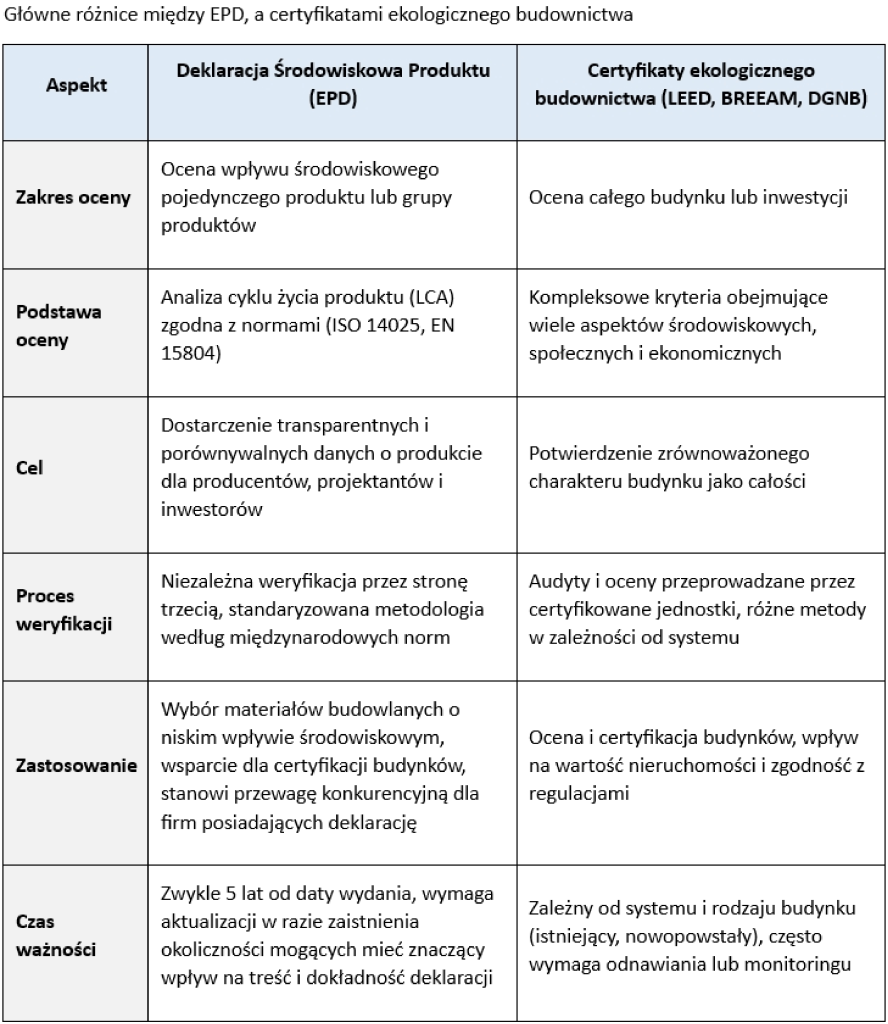
The differences between EPD certification and the other building assessment systems mentioned above are crucial for understanding the role of EPDs in construction. The key difference is that, unlike other certification systems that focus on assessing the entire building or project, EPDs analyze only the environmental impact of a specific product throughout its entire life cycle, providing an important tool to support these systems. Products with EPDs facilitate the earning of points by allowing for an objective assessment of the environmental impact of the materials used in construction and enabling comparisons between different solutions. 

Table comparing EPD with LEED, BREEAM and DGNB building certifications

Benefits of having an EPD

Having an EPD benefits both manufacturers and investors. It provides manufacturers with a competitive advantage , for example, in tenders and public procurement, as more and more customers are paying attention to the environmental aspects of construction products. Therefore, investing in obtaining an EPD can contribute to increased customer confidence and improve the company’s image in the construction market. 

Products with EPDs are often used in LEED, BREEAM, and DGNB-certified projects because they provide reliable data on the environmental impact of materials. This allows investors and designers to choose solutions that effectively contribute to achieving certification requirements and improving the building’s environmental performance.

Summary

Environmental Product Declarations (EPDs) and green building certificates are complementary tools for sustainable development in the construction industry. EPDs focus on transparent and detailed descriptions of the environmental impact of individual products, while certificates such as LEED, BREEAM, or DGNB comprehensively evaluate entire buildings based on multiple criteria. In practice, using products with EPDs is a key element in achieving high ratings in building certification systems, which translates into increased investment value and improved user comfort. 

It’s worth noting that EPDs are becoming not only a tool for meeting standards but also a competitive advantage. Companies investing in EPDs can expect better financial results and greater recognition from their customers. Therefore, it’s worth monitoring changes regarding these documents and their application in various aspects of the construction industry.

Certbud Sp. z o. o., as a leading certification body, supports companies in obtaining EPDs , offering comprehensive services, including training and consulting on obtaining these documents. Collaboration with our body contributes to achieving high quality standards and compliance with EN 15804 and ISO 14025.

Posted in EPD

Is an EPD mandatory?

An Environmental Product Declaration (EPD) is an increasingly popular document providing reliable information about a product’s environmental impact. But is it legally required? To answer this question, it is important to understand what an EPD is, what functions it serves and in what situations it may be needed.

What is an EPD and what are its functions?

An EPD (Environmental Product Declaration) is a document describing a product’s environmental impact throughout its life cycle, in accordance with the ISO 14025 standard. It indicates, among other things, raw material consumption, greenhouse gas emissions and waste generation. It is a Type III environmental declaration, meaning that it is based on objective data verified by an independent entity. Its primary goal is to provide transparent and reliable information regarding sustainability. As a result, EPDs are used in both the construction industry and other sectors, such as energy and industrial manufacturing, as a tool supporting informed purchasing decisions.

Is an EPD required by law?

Currently, in Poland and the European Union, having an EPD is not mandatory, but in many cases it is becoming increasingly desirable. This stems from growing market demands, particularly in the construction sector, where demand for certified building materials is increasing. For investors and designers, it is important to use products that support sustainable construction and help obtain environmental certifications such as BREEAM or LEED. Furthermore, new EU regulations, particularly the new CPR Regulation, which entered into force on 7 January 2025, indicate the increasing role of such declarations in the future.

Benefits of having an EPD

EPDs offer many benefits for manufacturers, investors and end consumers. These include:

  • Building market trust – an EPD demonstrates the transparency of a company’s operations.
  • Support for building certification – many building rating systems, including BREEAM, LEED and DGNB, require environmental data provided by EPDs.
  • A stronger competitive position – products with EPDs are more frequently selected in tenders and environmentally focused projects.
  • Cooperation with demanding partners – an increasing number of institutional clients require environmental information.

For manufacturers, an EPD can also support better management of production processes and help identify areas that require optimisation.

How to prepare an EPD?

Preparing an EPD requires collecting accurate data on the entire product life cycle – from raw material acquisition, through production and use, to recycling. The process includes:

  • conducting an LCA (Life Cycle Assessment),
  • selecting the appropriate certification body,
  • meeting the requirements of ISO standards such as ISO 14040 and ISO 14025.

The final step is verification of the documentation by an independent certification body, which ensures the credibility of the declaration. The entire process can be time-consuming, but it can bring tangible benefits in the long term.

Posted in EPD

EPD certificate – the key to sustainable construction

EPDs play a crucial role in sustainable development by providing information about the environmental impact of products. This allows manufacturers, architects, and investors to make informed decisions while minimizing negative impacts on the ecosystem. EPDs are becoming increasingly important in construction and industry, supporting the pursuit of sustainable practices and promoting a responsible approach to the use of natural resources.

The process of creating an epd certificate

The EPD process  begins with selecting the appropriate product and developing a study brief. This is followed by a detailed life cycle analysis, covering all stages from raw material extraction to disposal. Various methods and tools are used, such as LCA (Life Cycle Assessment). After data collection, an EPD report is created, which includes  environmental impact information and recommendations for use and disposal . This document is then verified by independent experts, ensuring its  credibility and accuracy . Finally, the EPD is published and made available to interested parties.

The role of the epd certificate in construction

The EPD certificate  plays  a key role in construction , influencing material selection and benefiting both investors and contractors. It is becoming an increasingly important criterion in purchasing decisions, driven by growing environmental awareness. By choosing products with an EPD, investors and contractors contribute to environmental protection and energy savings.  The EPD enables comparison of materials  based on their impact on human health and ecosystems, allowing for informed choices. This makes buildings more environmentally friendly and energy-efficient, translating into lower operating costs and a better quality of life for occupants.

Legal regulations regarding the EPD certificate

In the context of legal regulations,  the EPD certificate is gaining importance  in many countries. Sustainability regulations and construction standards influence its use in various sectors. Companies must be aware of legal requirements to remain competitive in the market. The introduction of EU directives, such as the Energy Efficiency Directive for Buildings, increases the demand for this certificate. In Poland, national and local regulations support the development of EPDs, which promotes sustainable construction. Understanding legal regulations is crucial for companies striving to achieve environmental goals and meet the expectations of customers and business partners.  Understanding legal regulations is crucial  for companies wishing to adapt to growing market demands.

Choosing an EPD certificate provider

When choosing an EPD certificate provider  , it’s worth considering several  key criteria . First and foremost, you should check the certification institution’s experience and reputation in the market. It’s also a good idea to seek out reviews from other clients who have used their services. Another important aspect is the cost of obtaining this document and the advisory support offered in preparing the necessary documentation. It’s worth comparing offers from different providers to choose the one most suited to your needs. It’s important to remember that the certificate should be issued by an accredited institution that meets international standards. Only then can you be sure of the reliability and credibility of the information obtained. 

Posted in EPD