



With society’s growing environmental awareness and sustainable development trends, tools for assessing the environmental impact of products and buildings are playing an increasingly important role. These include Type III Environmental Product Declarations (EPDs) and green building certifications such as LEED, BREEAM, and DGNB. While all of these systems aim to promote pro-ecological solutions, they differ in scope, purpose, and assessment method.
What is an environmental declaration (EPD) and sustainable building certificates?
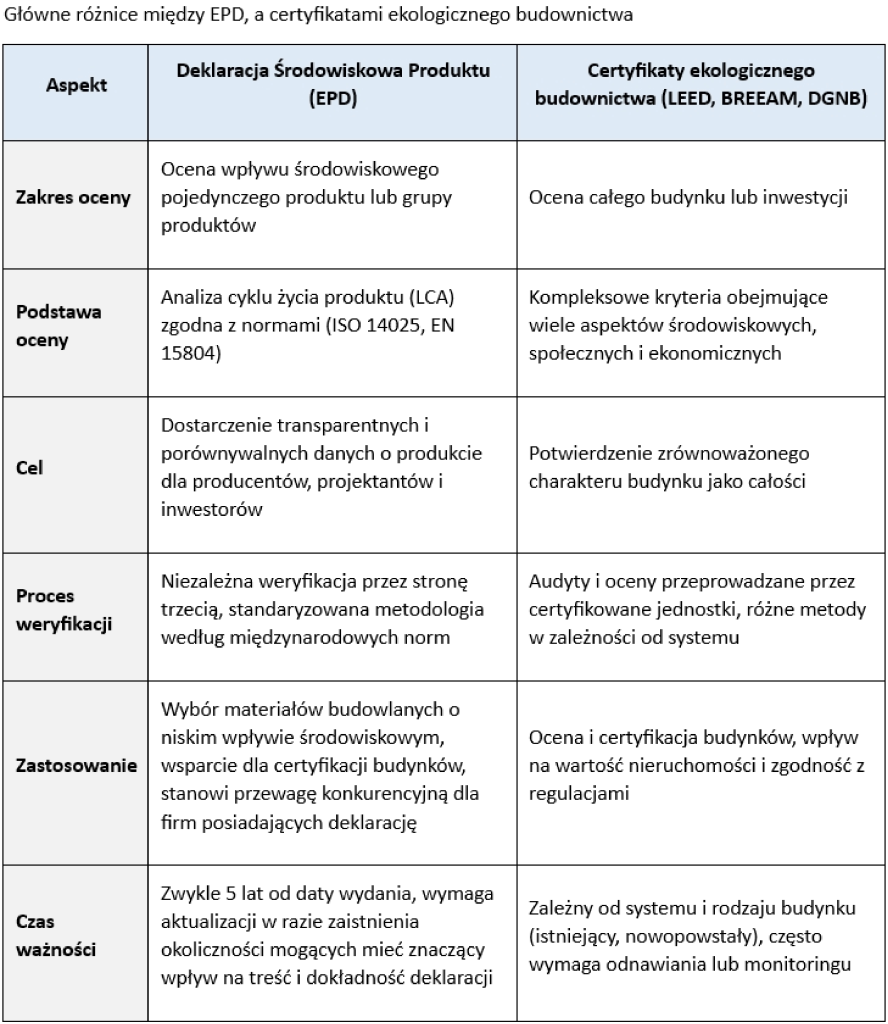
An environmental product declaration (EPD) is a detailed document describing the environmental impact of a specific product or product group throughout its entire life cycle – from raw material extraction and distribution, through production, use, and final waste management. The EPD is based on international standards such as ISO 14025, ISO 14040/44, and EN 15804 , ensuring its credibility and comparability. This document contains extensive environmental data, including CO2 emissions, energy and water consumption, and other potential pollutants. A key element is independent third-party verification, which confirms the declaration’s compliance with applicable standards.
Certifications like LEED, BREEAM, and DGNB are systems for assessing entire buildings for sustainability. They generally evaluate a wide range of aspects, such as energy efficiency, water consumption, waste management, use of recycled materials, and many others. Each system has its own specific criteria, often adapted to regional conditions, and the process culminates in a certificate confirming that the building meets specific environmental requirements.
Differences between EPD and other certificates
The differences between EPD certification and the other building assessment systems mentioned above are crucial for understanding the role of EPDs in construction. The key difference is that, unlike other certification systems that focus on assessing the entire building or project, EPDs analyze only the environmental impact of a specific product throughout its entire life cycle, providing an important tool to support these systems. Products with EPDs facilitate the earning of points by allowing for an objective assessment of the environmental impact of the materials used in construction and enabling comparisons between different solutions.
Benefits of having an EPD
Having an EPD benefits both manufacturers and investors. It provides manufacturers with a competitive advantage , for example, in tenders and public procurement, as more and more customers are paying attention to the environmental aspects of construction products. Therefore, investing in obtaining an EPD can contribute to increased customer confidence and improve the company’s image in the construction market.
Products with EPDs are often used in LEED, BREEAM, and DGNB-certified projects because they provide reliable data on the environmental impact of materials. This allows investors and designers to choose solutions that effectively contribute to achieving certification requirements and improving the building’s environmental performance.
Summary
Environmental Product Declarations (EPDs) and green building certificates are complementary tools for sustainable development in the construction industry. EPDs focus on transparent and detailed descriptions of the environmental impact of individual products, while certificates such as LEED, BREEAM, or DGNB comprehensively evaluate entire buildings based on multiple criteria. In practice, using products with EPDs is a key element in achieving high ratings in building certification systems, which translates into increased investment value and improved user comfort.
It’s worth noting that EPDs are becoming not only a tool for meeting standards but also a competitive advantage. Companies investing in EPDs can expect better financial results and greater recognition from their customers. Therefore, it’s worth monitoring changes regarding these documents and their application in various aspects of the construction industry.
Certbud Sp. z o. o., as a leading certification body, supports companies in obtaining EPDs , offering comprehensive services, including training and consulting on obtaining these documents. Collaboration with our body contributes to achieving high quality standards and compliance with EN 15804 and ISO 14025.
